Dubai – Business News Report|| Iraq is accelerating its exploration activities at the significant Abu Khaima oil field, located in Muthanna province near the borders with Saudi Arabia and Kuwait. This strategic move aims to unlock new reserves as part of broader national energy development plans.
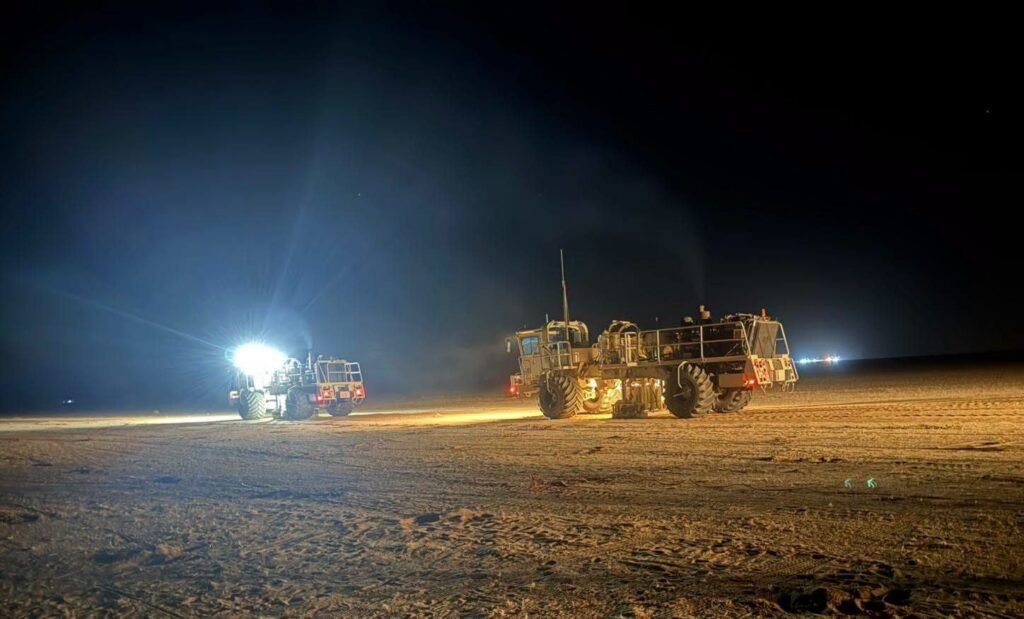
The Iraqi Ministry of Oil, through Dhi Qar Oil Company, has confirmed that ongoing two-dimensional seismic survey operations are currently underway at the site. These technical works are designed to enhance geological and geophysical data bases, supporting future evaluation and development phases for the field’s resources.
Operations cover an area of approximately 407 square kilometers. They are executed by the Oil Exploitations Company, represented by the Sixth Seismic Team, in coordination with Abu Khaima Petroleum Co., a Chinese operator managing the field. These activities fall under the Fifth Supplementary and Sixth Licensing Rounds.
Personnel from Dhi Qar Oil Company’s Muthanna Department oversee field supervision. This initiative emphasizes utilizing national expertise and Iraqi technical capabilities to improve operational efficiency. The goal is to support the ministry’s strategy of increasing domestic participation in specialized activities while leveraging local skills.
The seismic surveys aim to provide accurate data on subsurface geological structures. By recording reflected waves from rock layers, engineers can form visualizations of buried formations. This process helps identify areas warranting further study, though it does not guarantee commercial reserves.
Abu Khaima spans roughly 1809 square kilometers and was discovered in 1975 via a well reaching the Niyam formation. Currently, the field contains only one well. Chinese firms Zhenhua and Geo Jade previously bid for investment, with Zhenwin securing rights approximately eighteen months ago.
These exploration efforts align with Iraq’s target to increase crude oil production between eight and ten million barrels per day by 2030. A previous interim goal aimed for seven million barrels daily by 2027, facing challenges related to OPEC quotas and infrastructure needs.
Data from these surveys will guide future drilling programs and investment decisions. Success could bolster export options through pipelines linking to Turkish Ceyhan, Syrian Baniyas, or Jordanian Aqaba ports, alongside associated gas utilization projects.
This story was produced in the newsroom from the disclosed sources named above.