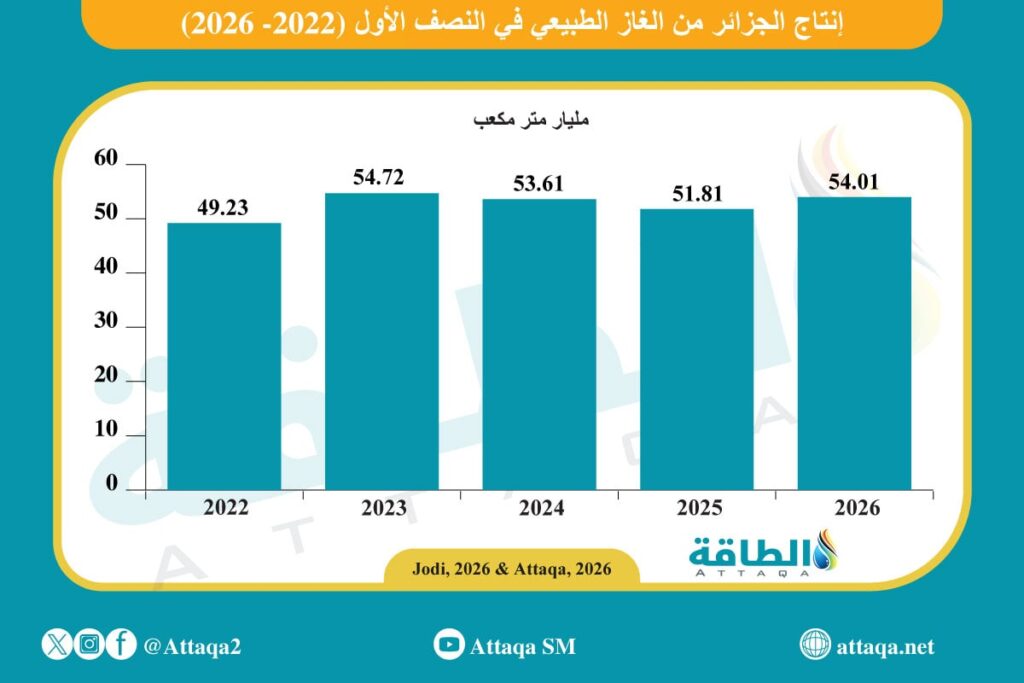
Algeria produced 54.01 billion cubic metres of natural gas in the first half of 2026, up 4.2 percent, or 2.2 billion cubic metres, from 51.81 billion cubic metres a year earlier. It is the strongest first-half figure the country has recorded in three years.
Back to 2023 levels
The first-half series shows output at 49.23 billion cubic metres in 2022, rising to 54.72 billion in 2023, then easing to 53.61 billion in 2024 and 51.81 billion in 2025 before this year’s rebound to 54.01 billion.
Monthly figures point the other way. June 2026 output came in at 8.17 billion cubic metres, 0.4 percent below the 8.20 billion of June 2025. The highest monthly level on record remains 13.18 billion cubic metres in March 2023, while January 2026 reached about 10.437 billion.
Domestic demand takes more than half
Local consumption rose 6.3 percent to 28.49 billion cubic metres from 26.81 billion in the first half of 2025, absorbing 53 percent of total output. Gas accounts for 99 percent of Algeria’s power generation, which explains the weight of internal demand.
In May the country opened its two largest solar plants, with a combined capacity of 400 megawatts, under a national programme targeting an additional 3.2 gigawatts by 2027.
Pipelines up, LNG down
Total gas exports rose 2.4 percent to 23.97 billion cubic metres in the first half, from 23.40 billion a year earlier. Pipeline shipments in June 2026 climbed to 3.06 billion cubic metres from 2.95 billion in June 2025.
Liquefied natural gas moved the other way, falling 6.5 percent to 4.47 million tonnes, the equivalent of 6.1 billion cubic metres. June 2026 LNG shipments were 899 million cubic metres, down from one billion cubic metres in June 2025, and July 2026 shipments came to about 0.495 million tonnes. January was the exception, with shipments rising to 0.440 million tonnes in 2026 from 0.389 million tonnes in 2025.
This story was produced in the newsroom from the disclosed sources named above.