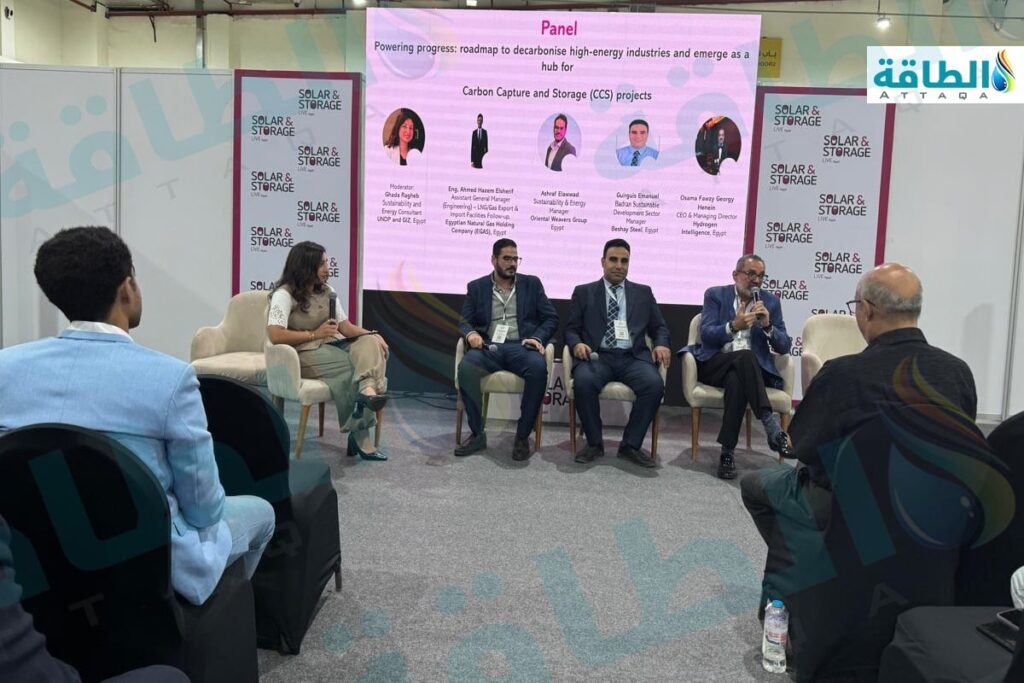
Sustainability managers at large Egyptian industrial groups and energy specialists laid out a practical sequence for cutting emissions from energy-intensive industry, at a panel held during the Solar Show MENA exhibition. The session was moderated by Ghada Ragheb, a sustainability and energy consultant with the United Nations Development Programme and the German development agency GIZ, and framed emissions reduction as a route to higher exports and to a regional role for Egypt in low-carbon solutions.
Efficiency before generation
Ashraf El Awad, sustainability and energy manager at Oriental Weavers, argued that energy efficiency should come first as the fastest and cheapest route, and that reviewing consumption patterns should precede any investment in renewable generation. He set out five steps in order: efficiency gains, renewable expansion, electrification of industrial processes, carbon capture and storage, and finally green hydrogen.
Steel and hydrogen
Gerges Badran, sustainable development director at Beshay Steel, called for establishing a baseline for energy consumption and identifying where energy is wasted, starting with low-cost measures before committing to larger investments. Bringing hydrogen into steelmaking, he said, means substituting it for natural gas in combustion and using it in reduction processes, alongside building a workforce of specialised engineers and technicians and training programmes covering safety procedures.
Infrastructure is the precondition, he added: investors need to know who will produce the hydrogen and how it will be transported. He compared the situation to the electric vehicle market, which faced a circular problem of too few charging stations and too few cars until state intervention broke it, and said hydrogen needs a similar model. Replacing natural gas requires heavy investment with unclear returns, he noted, and the limited market for green steel compounds the difficulty. His proposed answer is to work on two fronts at once: creating demand for low-carbon products, and providing concessional financing tools and green funds.
Doubts about carbon capture
Osama Fawzy Gerges, chief executive of the Hydrogen Intelligence platform, expressed reservations about relying on carbon capture, utilisation and storage, citing the high cost of deploying it in heavy industry and the fact that the technologies are still evolving. He said using captured carbon should take precedence over storing it outright, and questioned moving to storage without first examining utilisation options. On storage itself, he pointed to depleted oil and gas fields and to salt caverns, which Egypt does not have, as well as the risk of stored carbon dioxide leaking. He leans instead towards green hydrogen, and said technology choices should follow each industry’s needs and economics.
Pressure from export markets
Speakers identified steel, cement, fertilisers and aluminium as the most emissions-intensive sectors and the first candidates for transition, with flat glass, porcelain, ceramics and bricks following later. Carbon-linked trade policy, including the carbon border adjustment mechanism, will weigh heavily on these sectors, they said, making emissions reduction a core factor in competitiveness and in access to global markets.
This story was produced in the newsroom from the disclosed sources named above.