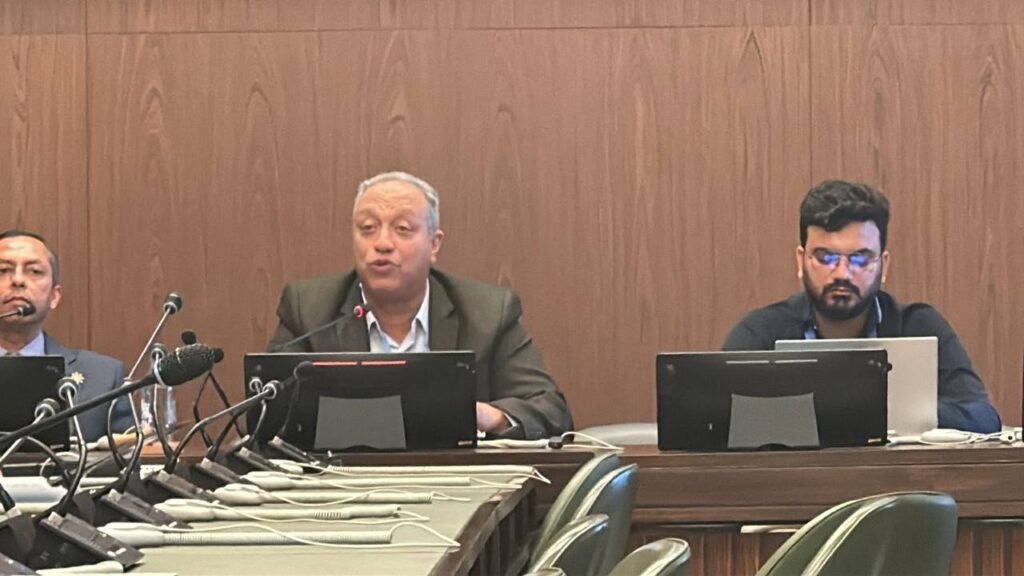
GENEVA, 14 September 2026 — Experts, civil society representatives and youth advocates gathered at the United Nations Human Rights Council in Geneva on Monday to warn that worsening water scarcity is increasingly becoming a human rights, governance and peace challenge rather than simply an environmental problem.
The discussion took place during a side event of the 63rd Session of the UN Human Rights Council, titled “Water Scarcity, Human Rights and Transboundary Water Governance.” The event was convened by the Global Institute for Water, Environment and Health (GIWEH), and co-hosted by the Youth Parliament for SDG and the International Eurasia Press Fund. GIWEH_Press_Release_HRC63_Water_Scarcity.pdf
Opening the session, GIWEH Director General Dr. Nidal Salim said water scarcity cannot be understood solely in terms of physical water availability. Climate change, population growth, pollution, inefficient use, infrastructure gaps and inadequate governance are increasingly affecting both access and equitable distribution. He stressed that access to safe water and sanitation is closely linked to health, food security, adequate living conditions and human dignity. GIWEH_Press_Release_HRC63_Water_Scarcity.pdf
Panelists emphasized that political and institutional decisions can determine whether communities have reliable access to water, particularly where rivers, lakes and aquifers cross national borders. They called for water governance policies that protect downstream populations, farmers, women and other vulnerable communities. GIWEH_Press_Release_HRC63_Water_Scarcity.pdf
Dr. Tobias Schmitz, Editor of The Water Diplomat, warned that some regions are moving beyond temporary “water crises” toward what he described as “water bankruptcy”—the depletion of groundwater, wetlands, rivers, lakes, glaciers and ecosystems on which future water security depends. Such damage, he said, can become prohibitively expensive or impossible to reverse within a meaningful human timeframe. GIWEH_Press_Release_HRC63_Water_Scarcity.pdf
Schmitz also noted that transboundary river basins account for close to 60 percent of global river flow, making effective cooperation between states essential. He argued that agreements must go beyond commitments on paper and include functioning institutions, joint monitoring, regular dialogue, data exchange and mechanisms for resolving disputes. GIWEH_Press_Release_HRC63_Water_Scarcity.pdf
The panel examined major shared-water systems including the Indus and Nile basins, highlighting the relationship between water governance, food security, livelihoods, environmental protection and human security. Youth speakers called for transparent and rights-based governance, stronger information sharing, ecosystem protection and meaningful participation by communities affected by decisions over shared water resources. GIWEH_Press_Release_HRC63_Water_Scarcity.pdf
Discussing the Nile and the Grand Ethiopian Renaissance Dam, Mira Farash stressed Ethiopia’s right to development while calling for cooperation and arrangements that protect downstream populations from disproportionate risks. She urged Ethiopia, Egypt and Sudan to pursue a comprehensive, legally binding framework addressing the dam’s operation, droughts, emergencies, data exchange and dispute settlement. GIWEH_Press_Release_HRC63_Water_Scarcity.pdf
The meeting concluded with calls for equitable water allocation, stronger institutions, modern infrastructure, joint monitoring, scientific cooperation and peaceful dispute-resolution mechanisms. Participants stressed that water should become a bridge for cooperation rather than a source of division, warning that failures in water governance ultimately threaten human dignity, livelihoods, health, food security and peace.
This story was produced in the newsroom from the disclosed sources named above.