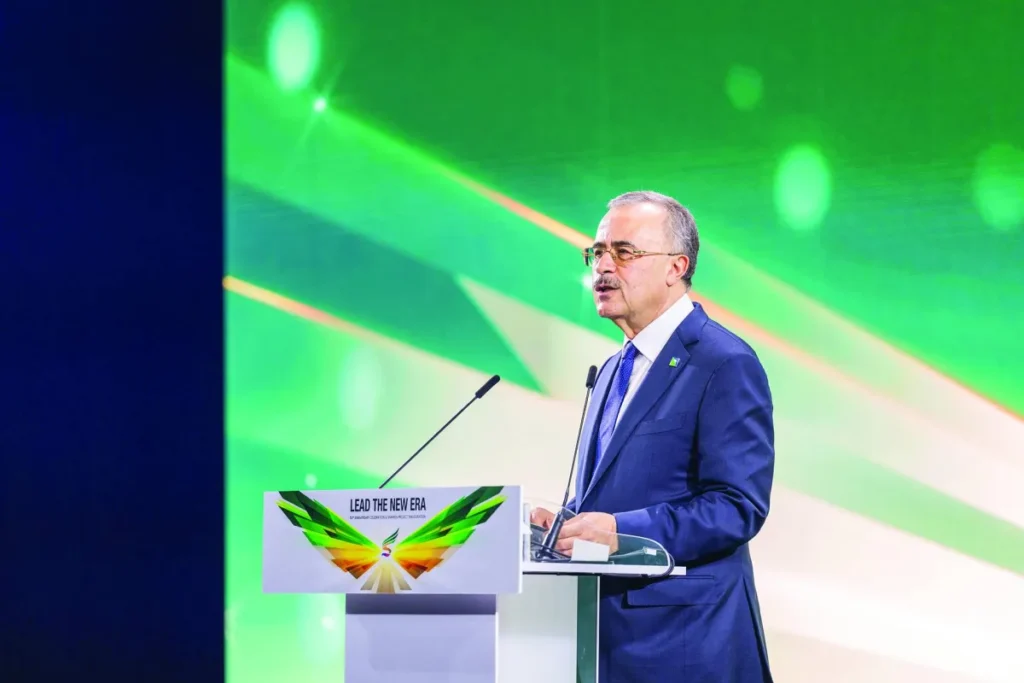
Dubai – Saudi Aramco CEO Amin Nasser stated that the Shahin petrochemical project in South Korea represents a strategic investment in advanced technologies. The company celebrated the commissioning of the facility on Wednesday, marking a significant milestone in its global operations.
Nasser emphasized that the project enhances the competitiveness of chemical products and opens new horizons for manufacturing industries. This includes key sectors such as semiconductors, automobiles, and artificial intelligence, which rely heavily on specialized materials.
In an interview with the Chosun Ilbo newspaper, Nasser revealed that the project involves investments totaling approximately 7 billion dollars, equivalent to 9.3 trillion Korean won. He noted that the initiative goes beyond expanding petrochemical facilities by employing advanced technology.
The core innovation allows for the direct conversion of crude oil into chemical materials. This approach aims to boost production efficiency while significantly lowering operational costs compared to traditional methods. The use of these competitively priced products in major Korean industrial complexes is expected to improve the standing of local manufacturing sectors.
Nasser pointed out that nine out of ten industrial products, including cars and AI components, require chemical materials. This dependency supports continued growth in demand for the outputs of the Shahin project, ensuring a robust market for its future production.
The project is set to begin commercial operations next year. It marks the first commercial application worldwide of the TC2C technology developed by Aramco. This method integrates refining and chemical production processes, differing from traditional naphtha cracking complexes.
Unlike conventional plants that process extracted naphtha, Shahin extracts chemical feedstocks directly from crude oil and heavy oils. This raises raw material efficiency and reduces the need for intermediate processing stages. The facility can convert 93 percent of raw materials directly into products.
While cost savings remain to be fully tested during commercial operation, the design ensures global price competitiveness even after accounting for investment costs. Eighty-three percent of raw materials are sourced internally, enhancing energy efficiency through integrated systems.
Aramco selected South Korea due to its subsidiary S-Oil and the integration at the Ulsan refinery. The location offers strategic advantages for exporting to Northeast Asian markets and proximity to large industrial clusters.
Nasser also discussed geopolitical challenges, describing recent Middle East conflicts as major crises. He announced plans to more than double joint oil storage contracts with the National Oil Corporation of Korea, aiming to increase capacity from 5.3 million barrels to over 11 million barrels.
This story was produced in the newsroom from the disclosed sources named above.