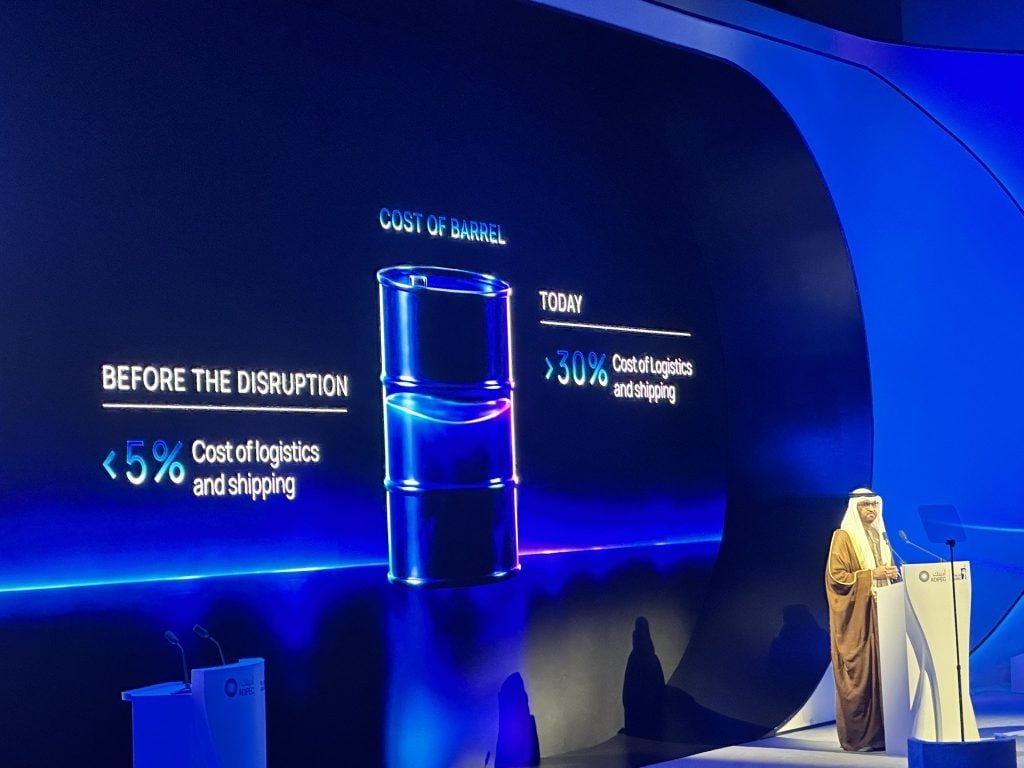
Dubai – The cost of transporting crude oil has skyrocketed due to ongoing geopolitical tensions, fundamentally altering the economics of global energy supply chains. Sultan Al Jaber, UAE Minister of Industry and Advanced Technology and Managing Director & CEO of ADNOC, disclosed that shipping and logistics expenses now account for approximately 30% of the total cost per barrel. This figure represents a dramatic escalation compared to the pre-crisis period, where such costs remained below 5%. The surge underscores the severe financial burden imposed on energy markets by recent navigational disruptions.
Strategic Reserves Depleted Amid Supply Shocks
Speaking at the opening of ADIPEC 2026, Al Jaber highlighted the rapid drawdown of global inventory buffers. He noted that the world has withdrawn roughly one billion barrels from strategic reserves since the disruption of maritime traffic through the Strait of Hormuz. This massive extraction has significantly eroded the buffer capacity available to absorb further shocks. Consequently, diesel stocks in certain markets have fallen to their lowest seasonal levels in 35 years. Meanwhile, other regions are facing a shortfall in liquefied natural gas supplies estimated at 600 billion cubic feet.
Redefining Energy Security Beyond Production
The crisis has exposed critical vulnerabilities in the current energy architecture. Al Jaber emphasized that securing production volumes alone is insufficient to guarantee supply security. The physical delivery of oil and gas to end-users has become a paramount factor in the energy security equation. This reality necessitates substantial investment in storage facilities, infrastructure, and robust logistical services. The sector must shift its focus from merely ensuring timely supply to preparing for emergency scenarios.
He argued that expanding strategic storage capacities and increasing product reserves near consumption centers are essential to mitigate disruption risks. Furthermore, developing secure access routes and investing proactively in infrastructure are crucial for maintaining market stability. Operational intelligence also plays a vital role, requiring a transition from simple automation to smart systems capable of anticipating risks and optimizing performance.
UAE’s Strategic Response and Human Capital
Al Jaber positioned the United Arab Emirates as a model for resilience in the face of global energy challenges. The nation continues to act as a strategic partner in providing reliable supplies and enhancing market flexibility. Abu Dhabi’s approach prioritizes dialogue, diplomacy, and political solutions to stabilize markets and support the global economy. ADNOC’s resilience plans were developed years ago, integrating trading, logistics, and international expansion in gas and chemicals.
The company relies on an AI-driven operational model designed to meet growing demand efficiently. However, Al Jaber stressed that human capital remains the cornerstone of energy security. Continuous supply depends on workers across production, operation, and transport sites, not just technology. The event, hosted at ADNEC from November 2 to 5, features 16 full halls and 30 national pavilions, expecting over 239 thousand participants from more than 170 countries.
This story was produced in the newsroom from the disclosed sources named above.